Best AI SEO Tools for Small Businesses in 2026: A Lean Stack That Won't Waste Your Week
Most small businesses do not have an SEO problem.
They have a workflow problem.
The keyword list lives in one tool, the draft lives in another, the owner edits the copy in Google Docs, nobody is fully sure what should rank, and the final page goes live without a clear internal linking plan. Then the team says AI SEO did not work.
Usually the real issue is simpler: too many moving parts, not enough editorial discipline.
If you are building your process from scratch, start with the broader AI writing tools directory, the AI search tools directory, and the more general How to Choose AI Tools Without Getting Lost in Hype. If you are already comparing vendors, keep the Software Evaluation Scorecard Template nearby so the buying decision stays grounded.
This article is for the owner, marketer, or lean content lead who needs a setup that helps publish useful pages every week, not a stack that looks impressive in screenshots.
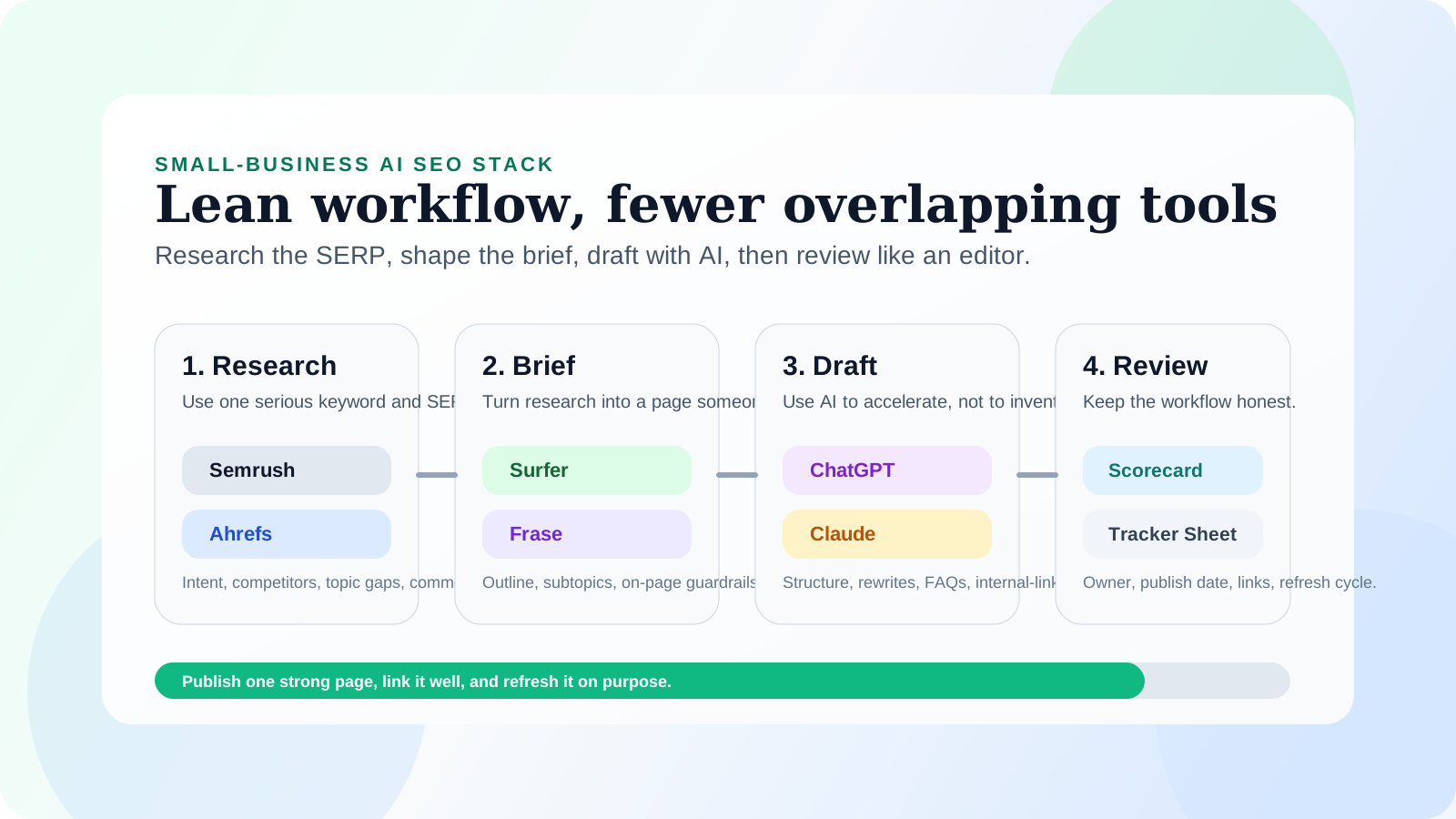
The short version
If you want the practical answer first, use the smallest stack that covers research, optimization, drafting, and review.
| Job to be done | Good first choice | Why it earns a seat |
|---|---|---|
| Keyword research and SERP framing | Semrush or Ahrefs | Gives you the search landscape, not just AI text generation |
| Content brief and on-page guidance | Surfer or Frase | Helps turn a loose keyword into a structured brief with optimization guardrails |
| Drafting, rewriting, and angle development | ChatGPT or Claude | Useful for first drafts, reframes, examples, and editing passes when you supply the real context |
| Editorial control and buying discipline | A spreadsheet plus the scorecard template | Prevents tool overlap and keeps the workflow tied to business outcomes |
That is enough for most small teams.
You do not need two SEO optimization suites, three AI writers, and a separate "content intelligence" product before your first strong article is even live.
Why small businesses overbuy AI SEO tools
The category is easy to overspend on because every demo shows the pleasant part.
- the tool produces an outline in seconds
- the dashboard suggests related keywords
- the editor gives you an optimization score
- the AI assistant rewrites a paragraph without complaining
None of that proves you will publish better pages consistently.
Small businesses usually overbuy for one of four reasons:
- they confuse content speed with content quality
- they buy overlapping tools before deciding who owns the workflow
- they expect AI to create firsthand insight that nobody on the team actually supplied
- they optimize drafts harder than they improve the offer, examples, or internal links
That is why I would not start by asking which AI SEO tool is "best."
I would start by asking where the current process breaks:
- are you struggling to find terms worth targeting
- are briefs too vague for writers to execute well
- do drafts sound generic and padded
- are pages going live without internal links or conversion intent
- are you paying for tools that no one uses after month one
The right stack depends on which of those is costing you the most.
The lean stack I would start with
For most small businesses, the cleanest setup has three software layers and one human layer.
1. A research backbone such as Semrush or Ahrefs
You need one place that helps you understand how a topic is actually searched, what already ranks, and how competitive the space looks.
That matters because AI writing tools are not reliable substitutes for search reality. They can help interpret a brief, but they should not be the only source of truth about demand, SERP shape, or ranking competition.
If your budget allows one serious SEO platform, this is where I would spend it first.
Use it to answer questions like:
- which keywords already have commercial intent
- what kind of pages are ranking now
- whether the query expects a tutorial, comparison, landing page, or template
- which related subtopics belong in the article and which ones will only dilute it
For a small team, the research tool earns its keep by helping you avoid writing the wrong page.
2. One optimization workspace such as Surfer or Frase
This is the layer that turns raw topic research into something a writer can execute.
The best use of these tools is not chasing a content score for its own sake. It is reducing blank-page friction. A decent optimization tool can help you shape a brief, cluster subtopics, and check whether the draft covers the obvious angles without forgetting the search intent.
If you choose this category, choose one product and learn it properly.
I would not pay for both Surfer and Frase at the same time unless your team already publishes enough content to justify side-by-side workflows. For most small businesses, that is duplicate spend.
3. One drafting assistant such as ChatGPT or Claude
This layer is powerful, but it should sit underneath your strategy, not replace it.
Use the model to do work like:
- turn a rough brief into three possible article structures
- rewrite weak sections in a clearer voice
- generate examples, FAQs, or objection-handling prompts
- compress interview notes into usable raw material
- suggest internal link opportunities from pages you already own
Do not ask it to hallucinate expertise you do not have.
If the page needs firsthand proof, screenshots, pricing nuance, customer language, or operational detail, you still need a human to provide that material. AI helps assemble and improve the draft. It does not magically invent trustworthy evidence.
4. A plain editorial tracker
This is the least glamorous part of the stack and one of the most important.
You need a simple place to track:
- target keyword
- page type
- owner
- draft status
- publish date
- internal links added
- conversion goal
- update date
That can be a spreadsheet. It does not need to be an SEO operating system.
If you are testing paid tools, the Software Evaluation Scorecard Template is the right place to compare them before the stack turns into a monthly bill nobody can explain.
A weekly workflow that actually fits a small team
This is the workflow I would use if a small business asked me to set up AI SEO without turning the process into a software hobby.
Step 1. Pick one revenue-adjacent topic
Do not start with the biggest keyword in the category.
Start with the page that can help a real buyer move one step closer to action. That usually means a comparison, use-case guide, pricing explainer, template, or problem-solving tutorial tied to the actual offer.
If the team still lacks a clear evaluation lens, review How to Choose AI Tools Without Getting Lost in Hype first. It prevents a lot of bad keyword choices that sound exciting but never convert.
Step 2. Build the brief in the research and optimization tools
Use your research platform to study the current SERP. Then use your optimization layer to turn that into a writer-friendly structure.
At this stage, I want answers to a few practical questions:
- what does the searcher really want
- what angle is already overused
- what proof or examples can we add that generic AI pages usually miss
- what internal pages should this article support
The brief should be specific enough that a writer does not need to guess the job of the page.
Step 3. Draft fast, then add the missing human detail
This is where ChatGPT or Claude becomes useful.
Let the model help with structure, transitions, alternative phrasings, and FAQ expansion. Then stop and add the parts that actually make the article worth reading:
- the real workflow
- the business tradeoff
- the examples from your niche
- the mistakes buyers make
- the advice you would give a customer on a call
That is the point where the article stops sounding like every other AI-assisted page on the internet.
Step 4. Optimize once, not forever
Run a final pass in the optimization tool, but do not turn the draft into a hostage situation where you rewrite decent prose for the sake of a score.
If the article is clear, specific, aligned with intent, and internally linked, you are usually closer to a good outcome than the team obsessing over the last few points in a sidebar meter.
Step 5. Publish, link, and schedule the refresh
A small business gains more from publishing one strong page and linking it properly than from generating six shallow drafts that never get revisited.
Before the page goes live, make sure you:
- add internal links from related articles or category pages
- include a clear next step for the reader
- note the publish date and refresh date in the tracker
- capture what you learned for the next article
If you already know the tool will need a live pilot before rollout, pair this workflow with the Software Pilot Plan Template. It keeps the evaluation grounded in real usage instead of vendor promises.
What each layer is genuinely good at
The easiest way to waste money is expecting every tool to do every job.
| Layer | Best at | Weak when |
|---|---|---|
| Semrush or Ahrefs | Query discovery, competitor framing, SERP research, opportunity sizing | You expect it to write differentiated copy by itself |
| Surfer or Frase | Turning search intent into briefs, optimization passes, content structure | You let the score override common sense and editorial judgment |
| ChatGPT or Claude | Draft acceleration, rewriting, angle generation, FAQ expansion, internal-link ideation | You rely on it for factual grounding or firsthand insight without review |
| Spreadsheet or scorecard | Keeping ownership, status, and cost discipline visible | You ignore it once the tool trial starts |
That separation matters.
Once each layer has a clear role, the stack becomes easier to manage and much easier to trim later.
When I would skip a paid AI SEO tool entirely
Some small businesses should not buy an AI SEO suite yet.
I would hold off if:
- the team is not publishing consistently enough to learn from the output
- nobody can review the draft for accuracy and usefulness
- the site still lacks basic service, category, or product pages
- there is no owner for internal linking and refresh work
- the problem is really positioning, not content production
In that situation, a drafting model plus a simple editorial process is usually enough to prove whether the channel deserves more investment.
Paid AI SEO tooling helps most when the business already has enough content motion to benefit from a better system.
My recommendation for a small-business starting point
If I had to keep the setup brutally simple, I would do this:
- one research tool
- one optimization tool
- one general AI assistant
- one spreadsheet that tracks what shipped and what performed
That is the lean stack.
It is cheaper, easier to train on, and much more likely to survive past the first enthusiastic month.
If you are deciding whether a new tool really deserves a seat, score it against your current workflow using the Software Evaluation Scorecard Template. If the workflow itself still feels fuzzy, go back to How to Choose AI Tools Without Getting Lost in Hype. And if the winner is about to move into a real trial, use the Software Pilot Plan Template before the team starts paying for shelfware.
FAQ
What is the best AI SEO tool for a small business?
There is usually no single best tool. The best starting point is a lean combination: one research platform, one optimization workspace, and one drafting assistant that fits how your team already works.
Do small businesses need both Surfer and Frase?
Usually no. For most teams they solve a similar problem, so buying both tends to create overlap instead of better output.
Can ChatGPT or Claude replace an SEO platform?
Not fully. They are useful for drafting and restructuring content, but they are not a substitute for real keyword research, SERP analysis, or performance tracking.
How many AI SEO tools should a small business pay for at once?
For most small teams, two paid tools plus one general AI assistant is enough. More than that often adds complexity faster than it adds results.