Best Website Builders for Affiliate Marketing: What Actually Matters Before You Publish 50 Articles
Affiliate sites are easy to start and surprisingly hard to keep clean.
The first few pages usually go up fast. A homepage, a couple of reviews, a comparison page, maybe a buyer guide. Everything feels manageable. Then the content footprint grows. You add tables, update links, publish seasonal pages, compare tools in batches, and realize the real problem was never "How do I launch a site?" It was "Which builder still feels efficient when the site becomes an editorial system?"
That is the lens I would use before choosing a website builder for affiliate marketing.
If you are still narrowing the category, start with the Website Builders directory, then open the individual Webflow profile, Framer profile, and the head-to-head Webflow vs Framer comparison. If you need a buying framework before committing, the software evaluation scorecard template is the right companion.
This article is written for people building content sites, review sites, niche software roundups, and lead-generation pages where search traffic matters.
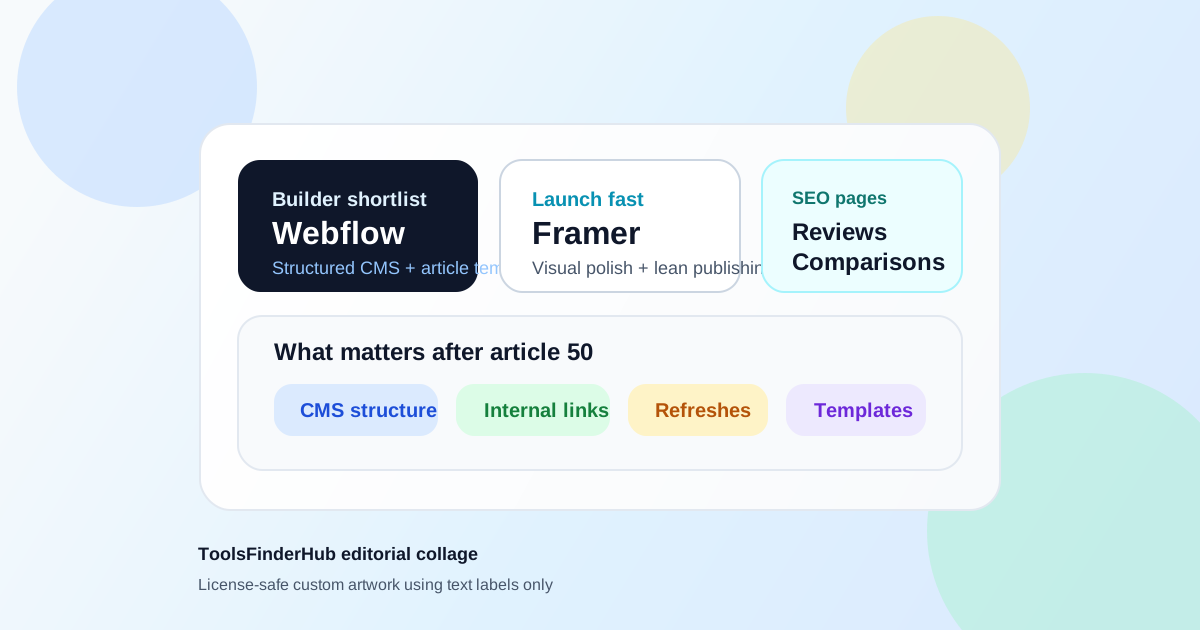
The Short Answer
If you want the quick version:
| Situation | Better fit | Why |
|---|---|---|
| You want a polished marketing site with strong visual control and are willing to structure CMS content carefully | Webflow | Better fit for editorial systems that need templates, collections, and tighter page-level control |
| You want to launch a fast, design-forward site with a lighter publishing workflow | Framer | Faster for leaner sites where brand feel matters more than deep content infrastructure |
| You expect hundreds of articles, plugins, and custom affiliate workflow logic | A heavier CMS stack, often WordPress | More flexible for scale, but also more maintenance-heavy |
That answer is incomplete unless you know what kind of affiliate site you are actually building.
Affiliate Marketing Sites Break for Different Reasons
People talk about affiliate websites as if they are one category. They are not.
A founder building ten landing pages for SaaS referrals has a different set of needs than a publisher planning 200 buying guides. A niche creator monetizing tutorials has different requirements than an SEO operator publishing large comparison libraries.
Before comparing builders, define the site type:
- content-led review site with category pages and comparison articles
- landing-page-led referral site with a smaller content footprint
- hybrid media site with tutorials, tool roundups, and newsletter capture
- programmatic or semi-programmatic site with repeatable page structures
The wrong builder often looks fine in month one. Problems appear around month four, when you need to update structure instead of just adding another page.
What Matters More Than Pretty Templates
Affiliate builders should be judged on publishing behavior, not on demo aesthetics.
Here are the five things I would care about most:
1. CMS structure
Can you create reusable article, comparison, and category templates without fighting the system every week?
2. Editorial speed
Can you draft, edit, and publish without turning each article into a design exercise?
3. SEO control
Can you manage title tags, meta descriptions, clean URLs, internal linking patterns, schema support, and indexable archive pages without awkward workarounds?
4. Updating at scale
If you need to refresh 40 articles after a pricing change, can the system handle that gracefully?
5. Conversion flexibility
Can you place comparison tables, call-to-action blocks, lead magnets, and affiliate disclosures where they belong without breaking the reading experience?
Nice animations are optional. Repeatable publishing is not.
Webflow: Better When the Site Needs Real Content Architecture
Webflow is the stronger option when you are building an affiliate site that starts to behave like a real publishing property rather than a simple landing-page stack.
That is because Webflow is more comfortable when the site needs:
- repeatable templates for reviews, alternatives, and comparison pages
- structured collections for tools, categories, authors, or use cases
- more deliberate control over information hierarchy
- stronger separation between design system and content entries
For affiliate marketers, that matters because growth usually creates content patterns. You do not just publish one article. You publish a family of pages that need consistent layout, CTA placement, disclosures, summary boxes, and internal links.
Where Webflow tends to win
- building a site that mixes editorial content with polished conversion pages
- creating reusable CMS-driven layouts
- managing a cleaner visual system across many pages
- giving designers more control without rebuilding every page manually
Where Webflow can become annoying
- if the team wants the absolute fastest path from blank canvas to published site
- if content editors dislike working through a more structured setup
- if the site will eventually need broader plugin-style behavior outside the builder's comfort zone
My practical read: Webflow makes more sense when you already believe the site will become an asset, not just an experiment.
Framer: Better for Leaner Sites That Need Momentum
Framer is appealing because it reduces friction.
If you are a solo operator, designer-founder, or marketer trying to launch quickly, Framer often feels more immediate. It is especially attractive when the site is relatively focused:
- a personal brand with monetized recommendations
- a niche landing-page network
- a productized-service site with a blog attached
- a small affiliate content hub where design and speed to launch matter more than deep CMS operations
Framer is easier to like when the publishing system is not too demanding. That is the key qualifier.
Where Framer feels strong
- shipping a visually sharp site quickly
- iterating on layout without much ceremony
- keeping the stack simple for a smaller site
- launching idea-driven content projects where speed matters
Where Framer starts to feel narrow
- when the editorial model gets more complicated
- when you need deeper repeatable content structures
- when the site becomes less like a portfolio and more like a database-backed content property
That does not make Framer a weak choice. It just means it is best when the site scope stays honest.
The Real Question: How Big Will the Content Engine Get?
This is where people make the wrong call.
They choose the builder that feels nicest while designing the homepage instead of the builder that will feel least painful when:
- the site has 75 articles
- comparison pages need a consistent template
- disclosures need updating across many pages
- internal links need a repeatable pattern
- authorship, categories, and content types start multiplying
If you expect the site to become a content machine, builder ergonomics around structure matter more than page-level delight.
A Practical Scenario Breakdown
Choose Webflow if your affiliate site looks like this
- you plan to publish buyer guides, reviews, alternatives, and comparison pages every month
- you want a stronger system for reusable content templates
- the site needs a more mature blend of brand polish and structured CMS content
- someone on the team is willing to invest in a cleaner setup upfront
Choose Framer if your affiliate site looks like this
- the site is lighter, newer, or more brand-driven
- you care about launch speed more than future CMS depth
- the content plan is meaningful but not massive
- you want to test positioning before investing in heavier structure
Consider a traditional CMS if your affiliate site looks like this
- you expect very large content volume
- you need plugin-driven SEO or monetization workflows
- the team is comfortable owning more operational complexity
- content operations matter more than visual-builder convenience
The mistake is pretending these are all the same project.
My Bias as an Operator
For affiliate projects, I would rather choose a platform that is slightly less exciting on day one and slightly less painful on day 200.
That pushes me toward Webflow over Framer for many serious affiliate builds, especially if the plan includes:
- content clusters
- repeatable comparison pages
- editorial refresh cycles
- structured collections for tools or offers
But I would still choose Framer for a founder-led affiliate project when the real business goal is speed of launch, quick positioning tests, and a smaller library of high-intent pages.
In other words:
- Webflow is usually the better long-game choice for a content-heavy affiliate site
- Framer is often the better short-game choice for a leaner site that needs to get live fast
That distinction is more useful than trying to declare one universal winner.
Common Mistakes When Picking a Builder for Affiliate SEO
Building for the homepage instead of the library
Affiliate growth usually comes from dozens of useful pages, not one beautiful hero section.
Underestimating content operations
Refreshing pricing mentions, changing affiliate disclosures, updating screenshots, and improving internal links are recurring jobs. The builder should make those jobs tolerable.
Confusing launch speed with publishing efficiency
A site that launches in two days can still become irritating to maintain after three months.
Ignoring page template needs
Review pages, alternatives pages, and "best of" lists benefit from repeatable structure. If each one becomes custom layout work, publishing slows down fast.
Over-focusing on tool popularity
Popularity is a weak decision criterion. Workflow fit is stronger. Always verify current pricing, SEO controls, and CMS limits directly on the vendor site before committing.
A Simple Decision Framework
If you are stuck, use this sequence:
- Estimate how many pages you reasonably want in the next 12 months.
- List the page types you expect to repeat.
- Decide whether the site is primarily a brand surface or a content engine.
- Check whether the builder supports those patterns without friction.
- Build one real article template before buying into the whole stack.
That last step matters. A builder can look perfect until you format an actual comparison article with tables, CTA blocks, disclosures, and internal links.
Final Take
The best website builder for affiliate marketing is not the one with the prettiest template gallery. It is the one that still feels workable when your site becomes a publishing operation instead of a side project.
Choose Webflow when you want stronger structure and expect the site to grow into a real content asset. Choose Framer when speed, simplicity, and visual momentum matter more than deep editorial infrastructure. If you expect a very large content footprint, keep a traditional CMS in the conversation too.
The important thing is to decide based on the library you plan to maintain, not just the homepage you want to launch.
FAQ
What is the best website builder for affiliate marketing?
For many content-focused affiliate sites, Webflow is the stronger fit because it handles structured content and reusable templates better. Framer is often better for smaller, design-led sites that need to launch quickly.
Is Framer good for affiliate SEO sites?
Framer can work well for lean affiliate sites, personal brands, and landing-page-heavy projects. It becomes less comfortable when the content model gets larger and more repetitive.
Is Webflow better than Framer for content-heavy affiliate sites?
Usually yes. Webflow is generally a better fit when the site needs repeatable CMS layouts, editorial scale, and cleaner long-term structure for review and comparison content.
Should affiliate marketers use a website builder or WordPress?
It depends on scale and technical appetite. Website builders are often easier to launch and maintain for smaller teams. WordPress and similar CMS setups become more attractive when the site needs heavier customization and a much larger content operation.
What should I test before choosing a builder for an affiliate site?
Build one real article template with a table, internal links, disclosure copy, and a CTA. That test reveals far more than a homepage mockup.