Software RFP Template: What to Ask Vendors Before You Book the Demo
Most teams do software demos in the wrong order.
They book five vendor calls, sit through polished walkthroughs, collect a pile of decks, and only then realize nobody agreed on what the team actually needed from the product in the first place.
That is the job of a software RFP. Not a bloated procurement document with fifty checkbox questions that nobody reads. A good RFP is a filtering tool. It tells vendors what problem you are trying to solve, what conditions matter, and what would make the shortlist real instead of political.
If you are still shaping the evaluation process, keep How to Choose AI Tools Without Getting Lost in Hype close. If the shortlist is about to hit live calls, use the Software Demo Script to keep vendors comparable. If you already have contenders, pair this article with the Software Evaluation Scorecard Template. If security review is likely to matter later, keep the Vendor Security Questionnaire Template nearby so the deal does not stall after the demo. And if the winner will go through a real trial, the next step is the Software Pilot Plan Template.
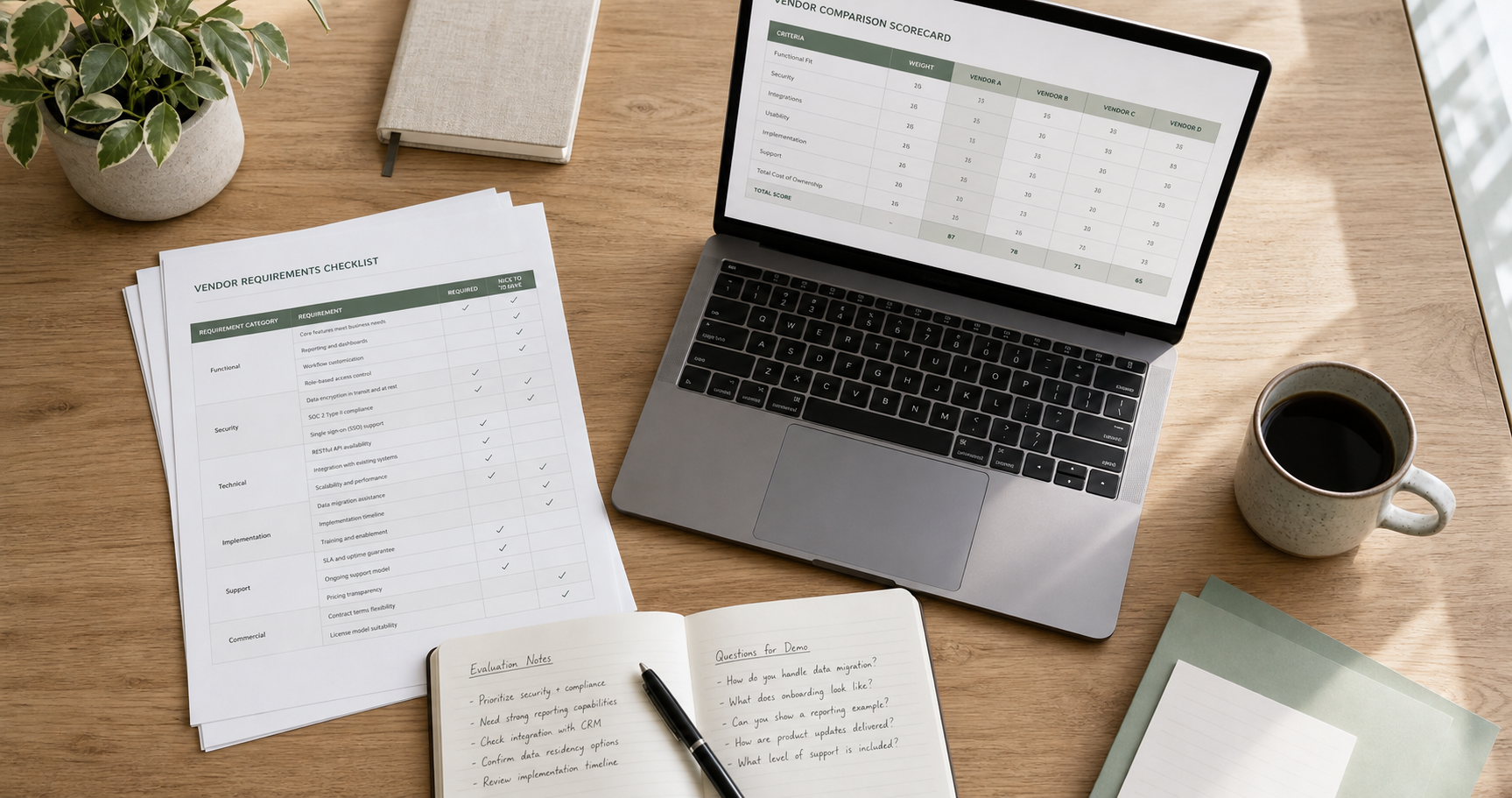
This is the lean software RFP template I would use before booking demos for a serious SaaS purchase.
What a software RFP should actually do
An RFP should make three things happen:
- weak-fit vendors opt out early
- plausible vendors answer the same decision-critical questions
- your internal team gets aligned on what matters before demo enthusiasm takes over
That is it.
If your RFP turns into a document that asks for every feature under the sun, vendors will still answer it, but the answers will get smoother and less useful. You want signal, not ceremonial paperwork.
When you should use a software RFP
Not every tool needs one.
If a single team lead is buying a low-cost point solution with little integration risk, a shortlist plus a scorecard is usually enough. But an RFP helps when:
- multiple departments will use the product
- the implementation will touch data, permissions, or workflow handoffs
- the contract value is meaningful enough that a wrong decision is expensive
- the team keeps debating priorities because nobody wrote them down yet
- vendors in the category all sound similar until you ask operational questions
In other words, use an RFP when you need clarity before you need persuasion.
The common mistake: asking for a demo before asking for fit
Founders, operators, and buyers often want the same thing from a first vendor call: "show us what you can do."
That sounds reasonable, but it gives away the most valuable part of the evaluation too early. Once the vendor sees where your team gets excited, the conversation naturally bends toward the polished path. That is normal sales behavior. It is also exactly why your written questions need to exist first.
A short RFP forces you to say:
- what workflow is being replaced or improved
- what systems the tool has to coexist with
- what risks would kill the deal
- what commercial assumptions need clarification before anyone spends an hour in a demo
The better your written brief is, the better your demo becomes later.
A lean software RFP template
Here is the structure I recommend. It is short enough that teams will maintain it, but specific enough that vendors cannot hide behind generic positioning.
1. Company and workflow context
Start with a short paragraph, not a corporate history lesson.
Include:
- your team size and primary users
- the workflow you are evaluating
- the current system or workaround
- the business reason the search is happening now
Example:
We are evaluating reporting and operations software for a 12-person ecommerce team. Today, weekly business reporting is stitched together across spreadsheets, ad dashboards, and manual Slack updates. We want a tool that reduces manual reporting work, improves visibility across channels, and supports manager review without adding another fragile workflow.
This section matters because vendors answer differently when they understand the real operating environment.
2. Scope of the evaluation
This is where you stop the project from drifting.
List:
- the workflow or use case in scope
- the user roles involved
- the timeline for vendor responses
- whether you expect a demo, sandbox, trial, or pilot after the written round
You are telling vendors what this evaluation is and what it is not. That alone cuts down a lot of noise.
3. Required capabilities
Do not ask vendors whether they have "advanced automation" or "powerful analytics." Those phrases are too vague to help.
Ask capability questions in a way that forces concrete answers:
| Area | Better RFP wording |
|---|---|
| Reporting | Describe how a manager builds, edits, shares, and exports a weekly report |
| Workflow | Explain how work moves from one user role to another |
| Permissions | Show how role-based access works for contributors, reviewers, and admins |
| Search | Describe how users find records, filters, or prior outputs quickly |
| Automation | Explain what can be triggered automatically and what still needs manual review |
If you want useful vendor responses, ask "how does this work in practice?" instead of "do you support this?"
4. Integration, security, and data handling
This section is where many teams stay too high level.
Instead of dumping a giant security spreadsheet into round one, ask the questions that affect shortlist viability:
- Which integrations are native today, and which require API work or partner support?
- How is data imported, exported, and deleted?
- What permission controls exist by role, team, or workspace?
- Is audit history available for workflow changes and admin actions?
- Which security or compliance standards are already documented?
You are not trying to complete a security review here. You are trying to determine whether a deeper review is worth anyone's time.
5. Implementation and adoption questions
This is where weak-fit products often reveal themselves.
Ask vendors to explain:
- a realistic onboarding sequence for your team size
- typical admin setup requirements
- the internal owner profile needed after launch
- training or enablement expectations
- what usually blocks adoption in the first 30 days
That last question is worth keeping. Good vendors answer it honestly. Weak ones dodge it.
6. Commercial model and support
Pricing confusion kills momentum late in the cycle because teams leave it vague too long.
Use the RFP to force clarity around:
- pricing basis: seats, usage, workspaces, credits, or modules
- onboarding or implementation fees
- premium feature gates
- support model and response expectations
- contract flexibility, renewal structure, and expansion assumptions
Do not ask only for list pricing. Ask what the product really costs once the team is running it the way it expects to run it.
7. Response format and next step
Vendors should not invent their own structure.
Tell them:
- the deadline
- the preferred response format
- the person or mailbox receiving answers
- whether shortlisted vendors will be invited to demo or pilot
- what criteria will determine the next round
This keeps the process fairer and makes comparison much easier internally.
Software RFP template you can copy
You can paste this directly into a doc:
Project summary
- Company/team:
- Workflow under evaluation:
- Current tool or workaround:
- Why this search is happening now:
Scope
- Primary users:
- Teams involved:
- In-scope workflow:
- Out-of-scope items:
- Expected next step after written review:
Required capabilities
- Describe how your product supports this workflow end to end:
- Explain role-based permissions for contributors, reviewers, managers, and admins:
- Show how data import, export, and historical reporting work:
- Explain automation, approvals, and exception handling:
- Note any important limitations we should understand before a demo:
Integration and security
- Native integrations relevant to our stack:
- API or middleware requirements:
- Data retention and deletion controls:
- Audit history and admin visibility:
- Compliance/security documentation available:
Implementation and adoption
- Typical onboarding timeline for a team of our size:
- Customer resources needed on our side:
- Training or enablement included:
- Common implementation blockers:
- What a successful first 30 days usually looks like:
Commercial model
- Pricing structure:
- Minimum commitment:
- Setup or services fees:
- Support level included:
- Notable add-ons or premium usage limits:
Response notes
- Response deadline:
- Demo availability:
- Trial or sandbox availability:
- Primary contact:
Questions worth asking before any demo
If I only had room for a few decision-shaping questions, I would ask these:
- What does the workflow look like end to end for a team like ours?
- What usually breaks or needs manual work in the first month?
- Which integrations are native, and which rely on API or custom work?
- What admin effort is required to keep the system healthy after launch?
- What cost drivers tend to surprise customers later?
- What would make you say we are not a strong fit?
That last question is uncomfortable, which is exactly why it is useful.
What not to include in the first RFP
Resist the urge to front-load everything.
A first-round RFP does not need:
- every legal and procurement clause
- every imaginable feature request
- twenty pages of security requirements
- edge-case workflows that do not affect the buying decision yet
Those things matter later, but dumping them into the first pass makes vendors pad their response instead of clarifying fit.
How to use vendor responses without turning it into spreadsheet theatre
Once answers come back, do not score every sentence equally.
I would review responses in three passes:
Pass 1: Eliminate obvious poor fits
Remove vendors that clearly miss a must-have workflow, integration, security requirement, or commercial constraint.
Pass 2: Prepare demo questions
Turn vague written answers into live proof requests for the demo:
- "Show us how that approval chain works."
- "Walk us through the export with a normal user account."
- "Demonstrate how quickly a new manager can build the weekly report."
Pass 3: Feed the shortlist into your scorecard
Use the RFP output as evidence inside your software evaluation scorecard, not as a replacement for it.
The RFP narrows the field. The demo shows product behavior. The pilot proves real fit.
A simple rule for founders and lean teams
If your team is small, your RFP should be even simpler.
A founder-led buying process does not need enterprise theatre. It needs a one-page document that makes the shortlist smarter. The moment the RFP becomes a proxy for internal indecision, it stops helping.
Write the questions that protect the next decision. Skip the ones that only make the document look official.
That is the whole game.
FAQ
What is a software RFP?
A software RFP is a request for proposal sent to vendors before deeper evaluation. It explains the workflow, requirements, and buying context so vendors can respond in a comparable format.
How long should a software RFP be?
For most SaaS evaluations, one to three pages is enough for the first round. The goal is clarity, not procurement theatre.
Do small teams need an RFP?
Not always. Small teams can skip it for low-risk purchases. It becomes useful when multiple stakeholders, integrations, or meaningful contract value are involved.
What should happen after the RFP stage?
Shortlisted vendors should move into a structured demo and then, if the tool still looks viable, a focused pilot. That is where written claims meet real workflow evidence.
What is the difference between an RFP and a scorecard?
The RFP gathers structured vendor input before the demo. A scorecard helps your team compare options using consistent criteria during and after evaluation.