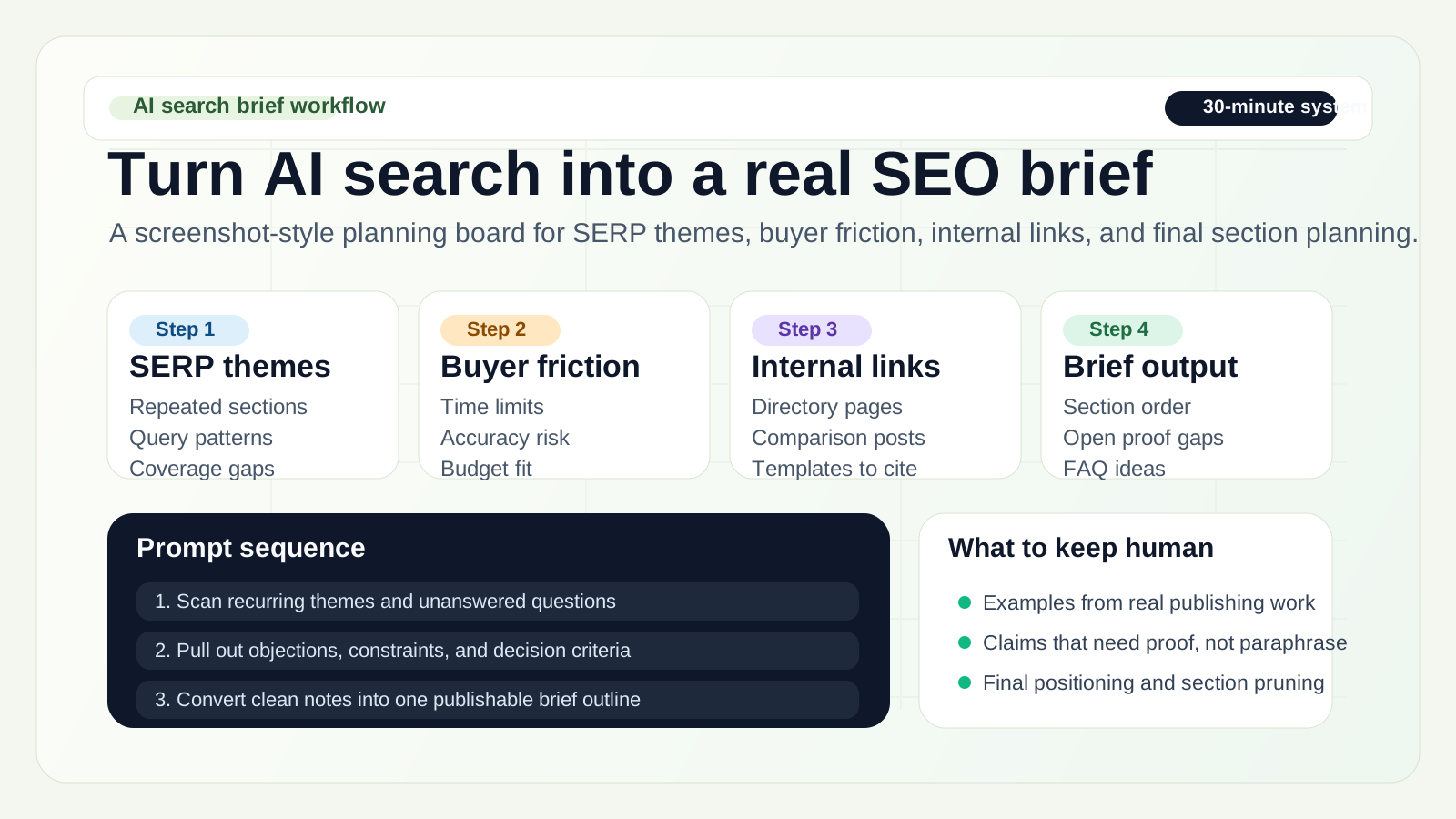
How to Use AI Search Tools for SEO Content Briefs in 2026: A 30-Minute Workflow for Lean Teams
Most teams do not need more SEO content ideas.
They need better raw material before the draft starts.
That is where AI search tools can actually help.
Used well, they speed up the messy middle of content research: summarizing competing pages, surfacing repeated questions, identifying commercial angles, and turning scattered notes into a brief a writer can use. Used badly, they just generate confident blur that gets pasted into the page and quietly makes the final article worse.
If you are still building the surrounding stack, start with the AI search tools directory, the AI writing tools directory, and the broader guide to Best AI SEO Tools for Small Businesses in 2026. If your team is also deciding which drafting assistant fits better after the research stage, the companion comparison of ChatGPT vs Claude for SEO Content is the next logical read.
This article is about one narrower question: how to use AI search tools to produce a better SEO content brief in about 30 minutes.
The big mistake: asking AI search to write the article
The most common failure pattern looks like this:
- someone enters a keyword into an AI search tool
- the tool returns a polished answer with a few citations
- the team treats that answer like the draft
- the published page ends up sounding generic, secondhand, and over-compressed
That is not a search problem. It is a workflow problem.
AI search is usually more useful before the draft than during it. I want it helping me answer questions like:
- what angles keep showing up across the SERP
- what buyer questions seem repeated and commercially relevant
- what proof points are still missing from my own page
- which subtopics deserve a section and which ones are just filler
- where the article needs real examples, not more summary
That is a much better use of the tool.
What a good AI-search-assisted brief should contain
By the time the research pass is done, the brief should give the writer five things:
- a clear search intent and page angle
- the core sections the page probably needs
- the unanswered questions or objections worth addressing
- the internal pages that should be linked naturally
- a short list of facts, examples, or evidence still missing
Notice what is not on that list: a full AI-generated article.
The brief is supposed to make the draft better, not replace judgment.
The 30-minute workflow I would actually use
This is the fastest repeatable flow I would use for a lean content team, founder-led site, or operator publishing one strong article a week.
| Time | What to do | What you are trying to get |
|---|---|---|
| 0-5 minutes | Frame the keyword and page angle | A clear statement of who the page is for and what job it should do |
| 5-10 minutes | Use AI search to summarize repeated SERP themes | A shortlist of recurring subtopics, questions, and comparison patterns |
| 10-15 minutes | Ask for missing buyer context | Objections, constraints, budget concerns, and decision criteria |
| 15-20 minutes | Separate evidence from filler | A tighter note set that keeps facts and drops decorative fluff |
| 20-25 minutes | Map internal links and supporting assets | Existing pages, templates, directories, or comparison links to include |
| 25-30 minutes | Turn the notes into a working brief | One outline the writer can actually execute |
That is enough for a useful first brief.
Step 1: define the page before you start searching
Before I touch an AI search tool, I write three lines:
- primary keyword
- target reader
- page job
For example:
- primary keyword: AI search tools for SEO content briefs
- target reader: founder, solo marketer, or lean content lead
- page job: help them build a fast research workflow without publishing AI sludge
That framing matters because AI search tools are very sensitive to vague prompts. If you start with a fuzzy request, the summary usually drifts toward consensus language instead of editorially useful detail.
Step 2: use AI search to find repeated SERP patterns, not just answers
This is where AI search starts earning its keep.
I am not asking for a finished article. I am asking for a map.
Here are the kinds of prompts that work better:
- "Summarize the recurring themes in top-ranking pages for this keyword."
- "List the reader questions those pages repeatedly answer."
- "Separate informational angles from commercial or tool-selection angles."
- "Show where the pages overlap heavily and where there is still room for a differentiated angle."
That gives me a clearer view of SERP shape without pretending the tool has done the editorial work.
If you are still comparing vendors, keep the Software Evaluation Scorecard Template nearby. It is useful when the content brief turns into a buying guide and you need consistent selection criteria instead of scattered impressions.
Step 3: ask for decision friction, not just topic summaries
This is the step many briefs skip, and it is the reason so many AI-assisted pages sound incomplete.
Topical summaries are easy. Buying friction is harder.
Once I know the common themes, I ask the tool for the practical concerns a real reader might bring into the search:
- what would make someone distrust this workflow
- what budget or time constraint changes the recommendation
- what kind of team would need a different approach
- what would make this advice fail in practice
Those answers often produce the most valuable sections in the article because they move the page away from bland explanation and closer to real use conditions.
Step 4: strip out everything that sounds polished but empty
AI search tools are good at compressing patterns. They are also good at inventing "smooth" sentences that say very little.
After the first pass, I clean the notes aggressively.
I delete:
- broad claims that could apply to any tool category
- phrases that sound consultant-approved but evidence-light
- repeated subtopics that do not change the reader's decision
- filler explanations that only restate the keyword
Then I keep:
- recurring questions
- concrete workflow steps
- differentiators that affect adoption
- proof gaps that need human examples or firsthand experience
This is the point where AI search becomes useful instead of merely fast.
Step 5: map internal links before the brief is finalized
Internal linking should not be a cleanup step at the very end.
If I am building this page on ToolsFinderHub, I already know a few natural destinations:
- the AI search tools directory for product discovery
- the AI writing tools directory for the drafting handoff stage
- the small-business stack guide to AI SEO tools for broader workflow context
- the ChatGPT vs Claude for SEO Content comparison for editorial handoff decisions
- the broader checklist on How to Choose AI Tools Without Getting Lost in Hype for evaluation discipline
Once those links are known early, the brief becomes more realistic because the page is not pretending to answer every adjacent question by itself.
Step 6: turn the research into a brief the writer can actually use
At this stage, I want one page of working guidance, not a research dump.
My final brief usually includes:
- target keyword and supporting variants
- audience and search intent
- article angle in one sentence
- required sections
- examples or proof points still needed
- internal links to weave in naturally
- the one or two claims that need extra verification before publishing
That is enough to hand off to a writer or to your drafting tool of choice.
A prompt stack you can reuse
If you want a compact prompt sequence, this is the shape I would use:
Prompt 1: SERP pattern scan
"Analyze the likely top-ranking page patterns for the keyword 'AI search tools for SEO content briefs.' Summarize repeated themes, user questions, and content gaps."
Prompt 2: friction scan
"For that keyword, list the buyer or operator concerns that would affect whether someone trusts or adopts the workflow. Focus on time, accuracy, budget, and editorial risk."
Prompt 3: brief assembly
"Turn the research into a concise SEO content brief for a lean team. Include page angle, section plan, FAQ ideas, and what still needs human evidence before publishing."
That sequence is usually better than one oversized master prompt because each step has a cleaner job.
Where I would hand off from AI search to ChatGPT or Claude
AI search is not the end of the workflow. It is the front half.
Once the notes are cleaned up, I would move to a drafting assistant for:
- outline refinement
- intro and CTA testing
- FAQ expansion
- section rewrites
- tone cleanup after the draft exists
If your team is deciding which drafting assistant fits that second stage, read the side-by-side breakdown of ChatGPT vs Claude for SEO Content. The best tool for research and the best tool for rewriting are not always the same seat.
Common mistakes that make AI-search-driven briefs weaker
Treating citations like proof of quality
A cited answer can still be shallow, overgeneralized, or misframed. Citations help, but they do not replace editorial judgment.
Keeping every subtopic the tool surfaces
Just because the tool found a topic does not mean the page needs it. Overcoverage is one of the fastest ways to make a page feel padded.
Skipping the "what is still missing" section
The best briefs say what the AI could not safely finish. That is where human examples, product screenshots, customer language, or firsthand operator notes should go.
Handing a messy research dump straight to the writer
If the notes are still noisy, the draft will usually inherit that noise. Cleanup is not optional.
Who this workflow is best for
This process works best when:
- one person owns research and publishing
- the team needs one strong page per week, not fifteen thin pages
- the business wants useful SEO content without a full editorial ops stack
- the writer is comfortable editing AI-assisted notes instead of copying them blindly
It works less well when the team has no editorial standards, no internal-link plan, and no appetite for human review. In that case, AI search usually accelerates bad habits instead of improving output.
My practical recommendation
If I were helping a small team today, I would use AI search tools as a briefing layer, not as a writing shortcut.
That means:
- use AI search to compress research
- use a drafting model to shape prose
- use human judgment to add examples, positioning, and proof
That division of labor is much healthier than asking one tool to pretend it handled the whole job.
If you are still assembling the broader stack, keep the AI search tools directory, AI writing tools directory, and the practical guide to Best AI SEO Tools for Small Businesses in 2026 in the same cluster. Together they form a more realistic workflow than any single all-in-one pitch.
FAQ
What are AI search tools best at for SEO content?
AI search tools are best at compressing research, surfacing repeated questions, identifying SERP themes, and helping shape a better brief before drafting starts.
Should AI search tools write the whole SEO article?
Usually no. They are more useful for research and brief creation than for producing the final publishable article on their own.
What should an SEO content brief include after AI search?
A good brief should include intent, audience, angle, required sections, key questions, internal links, and the evidence or examples still needed from a human.
What comes after the AI search step?
After research cleanup, hand the brief to a drafting assistant or writer for outline refinement, prose development, and editorial revision.