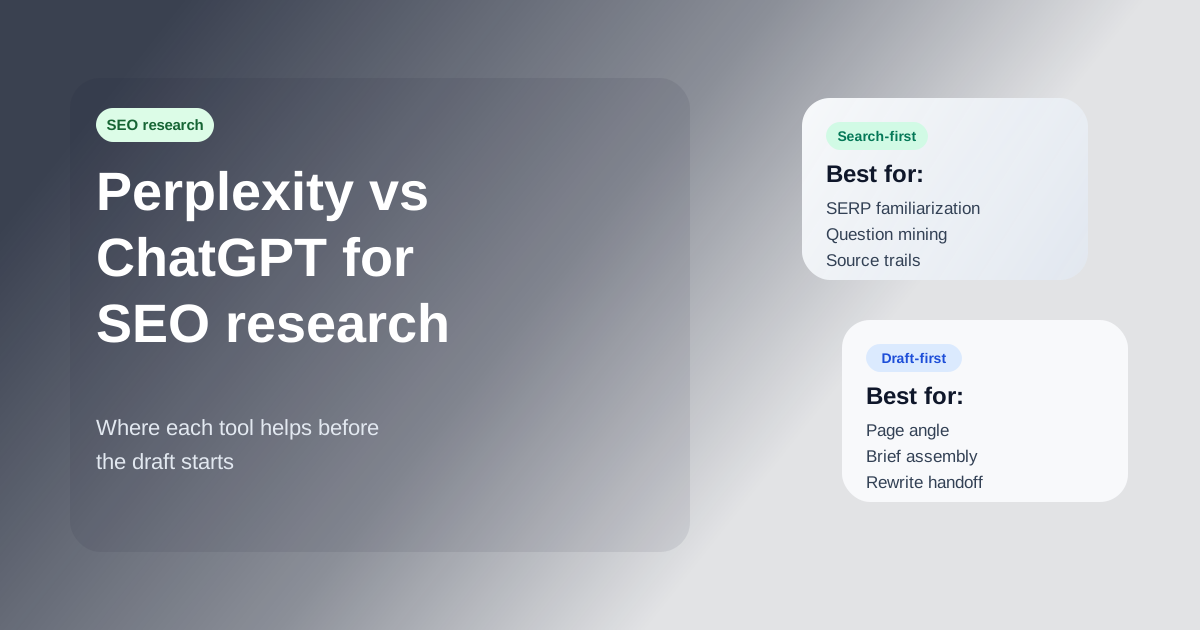
Perplexity vs ChatGPT for SEO Research in 2026: Where I'd Use Each Before the Draft Starts
Most "Perplexity vs ChatGPT for SEO" articles run the wrong test.
They ask both tools to generate a keyword list or a one-shot blog draft, then declare a winner based on which answer looks smoother.
That is not how lean content teams actually work.
The better question is this: where does each tool help before the article exists?
If you are still building the broader stack around the research step, start with the AI search tools directory, the AI writing tools directory, the wider guide to Best AI SEO Tools for Small Businesses in 2026, and the practical workflow for How to Use AI Search Tools for SEO Content Briefs. If the decision later shifts from research into drafting quality, the separate comparison of ChatGPT vs Claude for SEO Content is the more relevant next read.
This article stays focused on one narrower job: pre-draft SEO research for a small team that still needs to publish useful pages every week.
Short answer
If I need open-web familiarization, fast question mining, or a cleaner trail back to source material, I reach for Perplexity first.
If I need to turn messy notes into a page angle, a brief, a section plan, or a draft-ready decision framework, I reach for ChatGPT first.
That does not mean one is "for SEO" and the other is not. It means they are usually stronger at different parts of the same workflow.
The wrong comparison most teams run
The most common comparison goes like this:
- ask both tools for "keywords for X"
- ask both tools to "write a blog post about X"
- judge whichever answer looks more complete
That creates two problems.
First, it blurs research and drafting into one step.
Second, it rewards polish over usefulness.
SEO research is not just about generating more text. It is about reducing uncertainty before you commit to the page:
- what search intent are you actually serving
- what repeated questions keep showing up
- what subtopics look mandatory versus optional
- where do buyer objections appear
- which claims still need real evidence or firsthand examples
That is why a tool that feels "better at SEO" in a shallow demo can still be worse in a real publishing workflow.
Where Perplexity usually helps more
Perplexity is usually more useful to me when the job still looks like exploration.
That includes:
- getting familiar with a topic quickly
- collecting repeated language around a problem
- scanning for comparisons, objections, and side questions
- tracing ideas back to a visible set of sources
For small-team SEO work, that matters because the early stage is often messy. You are trying to get oriented without spending an hour opening twenty tabs first.
Perplexity is especially helpful when I want to ask:
- what questions keep showing up around this topic
- which subtopics are repeated across commercial pages
- where the conversation seems saturated
- what adjacent workflows or alternatives readers may also care about
That makes it a strong top-of-funnel research assistant.
It does **not** make it a replacement for manual SERP review, Search Console, or a real keyword database. But it can cut down the time spent getting from zero context to a usable map.
Where ChatGPT usually helps more
ChatGPT becomes more valuable once the notes exist and the real problem is synthesis.
That includes:
- sharpening the page angle for a specific reader
- turning scattered notes into a workable content brief
- separating main sections from decorative filler
- pressure-testing whether the outline actually answers the query
- drafting transitions, intros, FAQs, and CTA variants after the structure is clear
This is a different kind of usefulness.
Perplexity helps me see the territory. ChatGPT helps me decide what to build on it.
That distinction matters because a lot of SEO teams are not blocked by lack of information. They are blocked by too many notes and not enough editorial structure.
When the job becomes "turn this research pile into a page someone can publish," ChatGPT usually feels like the better seat.
My quick workflow for a lean SEO team
If I were running this stack with one operator, one editor, or a founder publishing alongside everything else, this is the sequence I would use:
| Stage | Tool I would start with | What I want out of it |
|---|---|---|
| Topic familiarization | Perplexity | Repeated questions, patterns, objections, and useful source trails |
| Page framing | Human + notes | Reader, search intent, page job, and what not to cover |
| Brief assembly | ChatGPT | Outline, section logic, FAQ candidates, and open proof gaps |
| Draft refinement | ChatGPT or Claude | Cleaner prose, tighter transitions, and rewrite support |
| Final editorial pass | Human | Accuracy, examples, claims, internal links, and conversion logic |
That division is usually more productive than trying to make one tool do everything.
If the research stage itself still feels fuzzy, read the separate breakdown of How to Use AI Search Tools for SEO Content Briefs. It covers the handoff from raw AI-search notes into an actual brief in more depth.
A practical test I trust more than one-shot outputs
If you really want to compare Perplexity and ChatGPT for SEO research, do not ask both for a finished article.
Run this instead:
- Pick one topic your site genuinely needs.
- Write the reader and page job in one sentence.
- Use Perplexity to map repeated questions, source trails, and adjacent concerns.
- Clean those notes manually for five minutes.
- Give the cleaned notes to ChatGPT and ask it to assemble a brief.
- Judge the result on whether the brief is clearer, narrower, and more publishable.
That is a better comparison because it respects where each tool is usually strongest.
Example prompts I would actually use
Perplexity prompt for the research pass
"I am researching the topic 'Perplexity vs ChatGPT for SEO research' for a small-team content site. Summarize recurring user questions, common comparison angles, likely objections, and adjacent tasks readers may also care about. Separate research-stage concerns from drafting-stage concerns."
ChatGPT prompt for the synthesis pass
"Using these notes, build a concise SEO content brief for a small-team operator deciding between Perplexity and ChatGPT before drafting an article. Include page angle, section outline, likely FAQs, internal link ideas, and what claims still need human verification."
The first prompt helps me gather shape.
The second prompt helps me make decisions.
That separation is the whole point.
Where teams get confused
There are three recurring mistakes I see:
1. Treating research output like publishable copy
A clean summary is not a finished page.
This is where a lot of AI-assisted SEO work starts sounding generic. The team mistakes "organized notes" for "an article with a point of view."
2. Confusing citations with certainty
Source trails are helpful, but they do not automatically make the analysis good.
The notes can still be shallow, repetitive, or commercially tone-deaf. Someone still needs to decide what matters to the reader and what does not.
3. Skipping manual framing
No tool can decide the page job for you.
Before either product becomes useful, you still need to define:
- who the page is for
- what decision or task the reader has
- what your article should help them do next
Without that, both tools tend to sound smarter than the page ends up being.
When I would choose Perplexity first
I would start with Perplexity when:
- the topic is new to me
- I need quick orientation across a messy question space
- I want a faster path into recurring concerns and cited source trails
- the site is still deciding whether the article should be informational, comparative, or commercial
This is the better fit when the bottleneck is research clarity.
When I would choose ChatGPT first
I would start with ChatGPT when:
- I already understand the topic reasonably well
- the notes exist but the angle is still loose
- I need a stronger brief, outline, or rewrite path
- the real issue is structure, not discovery
This is the better fit when the bottleneck is editorial decision-making.
When neither tool should be the main SEO system
There are also cases where both tools are secondary.
If you are planning a large content program, working through serious keyword allocation, or trying to understand traffic movement across a live site, the center of gravity should still be your SEO platform and first-party performance data.
That means things like:
- Search Console
- page-level performance history
- internal linking gaps
- ranking movement by cluster
- real conversion behavior after the click
AI tools can help interpret that work. They should not replace the measurement layer itself.
If I could only pay for one seat
This is where the answer gets less dramatic than most comparison posts want.
If the team already has a decent research base and mostly needs help turning notes into publishable structure, I would usually take ChatGPT.
If the team already knows how to write but wastes too much time getting oriented on unfamiliar topics, I would usually start with Perplexity.
If the business is still buying around the whole content workflow, keep the Software Evaluation Scorecard Template open while you compare. It is a better way to decide than asking which model felt more impressive on one afternoon.
My real verdict
Perplexity is usually better at helping you look outward.
ChatGPT is usually better at helping you decide what to do with what you found.
For SEO research, that distinction is more useful than pretending one of them simply "wins."
The highest-leverage workflow for a lean content team is often:
- use Perplexity for orientation
- use human judgment to cut noise
- use ChatGPT for structure and brief assembly
- move into drafting, rewrites, and final QA after the page angle is clear
That flow is slower than one-click content, but much more likely to produce something worth publishing.
If you are still assembling the broader stack around that workflow, the best companion reads are Best AI SEO Tools for Small Businesses in 2026, How to Use AI Search Tools for SEO Content Briefs, and ChatGPT vs Claude for SEO Content. Together they map the research, brief, drafting, and tool-selection layers much more honestly than a single "best AI for SEO" answer ever will.
FAQ
Is Perplexity better than ChatGPT for SEO research?
Usually for early-stage exploration, yes. Perplexity is often more useful when the goal is fast familiarization, recurring questions, and source trails. ChatGPT is often stronger once the notes already exist and you need structure.
Can ChatGPT replace Perplexity for content research?
Sometimes, but not always elegantly. If the topic is already familiar and the issue is synthesis, ChatGPT may be enough. If you still need faster orientation across an unfamiliar topic or angle, Perplexity often gives a cleaner starting point.
Do Perplexity or ChatGPT replace Ahrefs or Semrush?
No. They can help interpret a topic and speed up parts of the workflow, but they are not substitutes for keyword databases, ranking data, Search Console, or live site performance analysis.
What is the best small-team workflow?
Use Perplexity for topic familiarization, then clean the notes manually, then use ChatGPT to turn those notes into a brief or outline. That split usually creates a stronger draft than forcing one tool to handle the whole process.